The Staff
An ancient conduit channeling the Will and the Word.

In the world of Eddings, magical staves serve as conduits for the Will and the Word, allowing trained minds to shape reality through thought and will. While not a singular unique artifact like the Orb, 'The Staff' most commonly refers to the iconic walking stick wielded by Belgarath. It symbolizes his immense age, authority as a disciple of Aldur, and his role as the guardian of the Prophecy.
- Primary Wielder
- Belgarath
- Origin
- Unknown (simple wooden staff)
- Function
- Magical Focus / Walking Aid
- Affiliation
- The Prophecy / Disciples of Aldur
- First Appearance
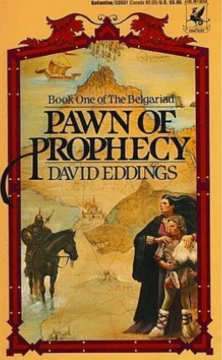
- Pawn of Prophecy
- Status
- Last seen with Belgarath
Lore & Background
The craftsmanship of these staves is never attributed to any specific people in the books. Unlike the Orb, which holds a singular destiny, the staff represents personal mastery and lineage. It is often depicted as simple wood, unadorned by gems, reflecting the belief that true power lies in the wielder's mind rather than the object itself.
In Their Own Story
The old man leaned heavily on the rough-hewn wood, his eyes scanning the horizon where the mountains met the sky. To Garion, it looked like a simple walking stick, worn smooth by centuries of grip. But when Belgarath tapped the tip against the earth, the ground hummed with a low vibration that only he could feel. He smiled, knowing the land itself was listening to his command.
Reader's Guide
These artifacts originate from the ancient Sormani civilization, crafted specifically for priests and mages capable of handling the Old Power. Usage requires intense mental discipline; without proper training, the staff is merely a stick. The rules dictate that magic flows through the user's intent, with the staff serving as a grounding rod to prevent psychic backlash. Limitations exist in that the object cannot create power from nothing; it only directs what the wielder possesses. A novice holding Belgarath's staff would achieve nothing without his centuries of experience. Narratively, these staves emphasize the burden of knowledge carried by the Elders. They distinguish the ancient guardians from younger mages who rely more on innate talent or the Orb.
Did You Know?
- Belgarath often uses his staff to disguise his true physical age and energy levels.
- The material of Belgarath's specific staff is never explicitly named in the text.
- Unlike the Orb, staves are not unique artifacts; each sorcerer typically has their own personal staff.
Origins and Early Struggles
Led by Don Bluth, along with colleagues John Pomeroy and Gary Goldman, a team of eleven animators departed during the production of The Fox and the Hound. Their departure was driven by dissatisfaction with Disney's perceived bureaucratic stifling and an assembly-line approach to filmmaking. Initially operating out of Bluth's home in Ventura, California, the group completed Banjo the Woodpile Cat, a project they had secretly developed for four years prior to leaving. Following this short film, they relocated to a facility in Studio City to undertake their first major feature, The Secret of NIMH. While critics praised the film's fluid animation, its box office performance was hampered by poor distribution strategies and competition from E.T., leading to financial instability. This period culminated in bankruptcy after the video game industry collapse left Cinematronics unable to pay over three million dollars owed for Dragon's Lair and Space Ace.
Relocation to Ireland and Expansion
A pivotal moment occurred during the production of An American Tail when the company negotiated a move from Van Nuys, California, to Dublin, Ireland. This strategic relocation was designed to capitalize on government incentives provided by the Industrial Development Authority (IDA). The transition saw most of the American staff migrate to the new Dublin facility while working on their second feature, The Land Before Time. To sustain operations and talent pipelines in the new location, the studio actively recruited local Irish artists and collaborated with Ballyfermot College of Further Education to establish a dedicated animation course. This expansion allowed them to sever ties with Amblin Entertainment later on, securing distribution deals with UK-based Goldcrest Films for subsequent titles like All Dogs Go to Heaven and Rock-a-Doodle, effectively establishing a transatlantic production model.
Financial Decline and Closure
Despite initial successes in Ireland, the studio faced mounting financial pressures by the early 1990s. To salvage these partially completed projects, new investors from Merlin Films and Media Assets stepped in. With leadership diverted and continued financial losses, Sullivan Bluth Studios officially ceased operations on October 31, 1995, following the release of their final feature, The Pebble and the Penguin.
Legacy and Rights Distribution
The intellectual property created by Don Bluth Entertainment is currently fragmented among major media conglomerates. Conversely, Amazon MGM Studios retains control over a significant portion of the catalog via United Artists and Metro-Goldwyn-Mayer; this includes The Secret of NIMH, All Dogs Go to Heaven, Rock-a-Doodle, and North American rights to The Pebble and the Penguin. Meanwhile, Universal Pictures continues to hold ownership of An American Tail and The Land Before Time through Amblin Entertainment. This complex distribution landscape reflects the studio's turbulent history of changing partners, from MGM/UA and Goldcrest to various investors who stepped in during financial crises, leaving a diverse legacy across the modern animation industry.
Frequently Asked Questions
Who wields The Staff?
It belongs to Belgarath Corinor, an Elder of Sorm who guides the Prophecy. He carries it constantly as a walking aid and magical focus throughout the books.
What powers does it grant?
The item functions as a conduit that channels the Old Power to strengthen the wielder's will. While not unique, it allows Belgarath to manipulate reality more effectively than unaided thought.
Where is it from?
Its creation dates back to ancient Sorm during the time of the original Elders. It represents the long lineage of magic users who served before Belgarath took his role.
Why does it matter?
Beyond its utility, the Staff serves as a symbol of Belgarath's authority among the Sormani Elders. It visually marks him as the guardian responsible for overseeing the fulfillment of destiny.
What is its final fate?
The artifact remains in Belgarath's possession after the defeat of Torak and the ending of the series. No text suggests it is ever destroyed or passed to another wielder.