Kingdom of Riva
A rugged island kingdom of warriors, defined by honor and a fierce refusal to bow.

The Kingdom of Riva stands as a formidable and often misunderstood power on the Isle of the Winds in the Sea of the West, distinguished by its fierce independence and martial culture. Unlike the sprawling empires of Mallorea or the pious realms of Sendaria, Riva is a nation defined by its rugged coastline, dense forests, and a population that values strength and honor above all else. Throughout the saga, it serves as a critical geopolitical pivot point, often caught between the machinations of the Angarak kingdoms, the ambitions of the Alorn nations, and the ancient plans of Torak.
- Region
- Isle of the Winds (Sea of the West)
- Primary Culture
- Rivan
- Key City
- Riva (Capital)
- Notable Ally
- The Alorn Kingdoms (Cherek, Drasnia, Algaria) and Sendaria
- Military Reputation
- Elite Infantry and Naval Power
- Status
- Sovereign Kingdom
Lore & Background
The kingdom plays a pivotal role in the unfolding of the Prophecy and the eventual defeat of Torak. It is here that the Rivan King wields the Orb of Aldur, a central artifact of the saga, and where the line of the Rivan King is preserved through generations. The capital city serves as a hub for political intrigue, where the fates of the world are occasionally decided in quiet councils before being enacted on grand battlefields. The Rivan people's loyalty is hard-won but unbreakable once given, making them a crucial component of the Alliance that eventually forms to confront the Dark Prophecy.
In Their Own Story
The salt spray of the western coast stung Garion's eyes as he watched the Rivan fleet weigh anchor against the grey dawn. The ships were not the gaudy vessels of Malloreon, but sturdy, practical craft built for war and trade alike. Below on the docks, a crowd of citizens stood silent, their faces set in expressions of grim determination rather than fear. They knew what was coming; they had seen the shadow of Torak lengthen across the land before. Yet, as the great banners of Riva snapped in the wind, there was no hesitation in their hearts. This was their home, and it would be defended with every ounce of strength they possessed.
Reader's Guide
The Kingdom of Riva operates under a traditional monarchical system, led by a King or Queen who holds significant authority but is often advised by a council of nobles and military commanders. The leadership prioritizes the defense of the realm and the preservation of Rivan traditions, which often puts them at odds with expansionist neighbors. Politically, Riva maintains a delicate balance, avoiding permanent alliances that might compromise its sovereignty while remaining ready to support allies when the threat becomes existential. Their goals are primarily defensive: ensuring the safety of their people and maintaining their cultural independence against the encroaching influence of larger empires. Military strength is the cornerstone of Rivan power. They field a highly disciplined infantry known for their prowess in close-quarters combat, supported by a capable navy that controls the western seas. Internal conflicts are rare but usually stem from succession disputes or disagreements over foreign policy, particularly regarding how much to engage with Malloreon or Cherek.
Did You Know?
- Garion, the heir to the Rivan throne, was raised in Sendaria and is the grandson of the previous Rivan King; Ce'Nedra is the Imperial Princess of Tolnedra, not of Rivan blood.
- The kingdom's location on the Isle of the Winds makes it a vital naval power in the Sea of the West.
- Rivan culture places an exceptionally high value on personal honor and martial skill.
- Despite its smaller size compared to the Mallorean continent, Riva has historically resisted conquest through sheer resilience.
Origins and Creative Genesis
David Eddings conceived The Belgariad with a pragmatic eye on the publishing market, observing the enduring reprints of J.R.R. Tolkien's works and identifying fantasy as an underserved yet lucrative genre. Initially writing in adventure and thriller categories, he mapped out an imaginary world to capitalize on this opportunity, though his approach evolved from cynicism into genuine creative passion. The series draws heavily from medieval epics and benefited significantly from the editorial guidance of Lester del Rey. Crucially, Eddings later acknowledged that his wife, Leigh Eddings, was an essential collaborator throughout the process. While she was not initially credited on the early volumes, she is now widely recognized as a co-author who helped shape the narrative foundation. This partnership eventually led to formal credit in subsequent works, highlighting how the saga's success was a joint endeavor rather than a solitary achievement.
Narrative Structure and Thematic Design
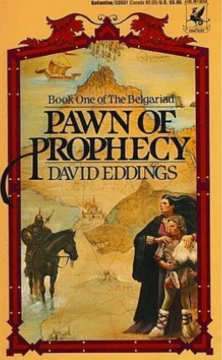
The Belgariad consists of five distinct novels published between 1982 and 1984, each title uniquely blending chess terminology with fantasy concepts to reflect the overarching 'Game of Destiny' motif. The saga begins with Pawn of Prophecy and concludes with Enchanters' End Game, establishing a cohesive epic that has been reissued in various formats, including two-volume sets. While these collections sometimes omit original cartography by Chris Barbieri in favor of maps by Shelly Shapiro, the core narrative remains intact. The story follows protagonist Garion as he navigates a world created by seven gods, where the central conflict revolves around the Orb of Aldur. This sacred stone, imbued with a living soul, was once seized by the antagonist Torak, leading to his mutilation and setting the stage for a prophesied struggle that spans generations and kingdoms.
Character Dynamics and Mythic Lineage
The narrative weaves together complex family ties and ancient prophecies, centering on Garion's discovery of his true heritage. Initially living a simple life on a farm with his aunt Pol and friend Durnik, Garion is thrust into adventure when the sorcerer Belgarath reveals that he is actually Garion's grandfather. This revelation connects Garion to Queen Beldaran and her husband Riva, whose lineage was tasked with protecting the Orb of Aldur from Torak. The journey expands as the group recruits diverse allies, including Silk, a Drasnian prince and spy, and Barak, an earl who can transform into a bear. These characters navigate political intrigue, such as plots against King Korodullin in Arendia, while confronting supernatural threats like the Algroths and the mocking shade of Chamdar, all driven by the Voice of Prophecy within Garion.
Legacy and Expansion of the Universe
Since its debut, The Belgariad has been celebrated as both a 'last gasp' of traditional fantasy and a foundational mega-saga for modern readers. Its commercial success was immediate, with the first book becoming a bestseller that launched a broader literary universe. This world expanded significantly beyond the original five books to include The Malloreon, a sequel series, as well as prequels focusing on Belgarath and Polgara. Additional materials like The Rivan Codex provided annotated background details, enriching the lore for dedicated fans. The saga's enduring impact lies in its ability to blend high fantasy tropes with accessible storytelling, creating a mythic framework that continues to resonate. By establishing a rich history involving seven gods and an eternal struggle between light and darkness, Eddings crafted a legacy that influenced countless authors who followed.
Frequently Asked Questions
What defines the Kingdom of Riva?
It is a sovereign western kingdom on the Malloreon continent defined by its rugged coastline and dense forests. The culture prioritizes strength and honor, leading to a fierce refusal to bow to foreign powers.
What military power does Riva possess?
The nation relies on elite infantry and a dominant naval force to protect its borders. This martial reputation allows them to resist the ambitions of larger empires like Mallorea or Cherek.
How does Riva fit into the geopolitical landscape?
It serves as a critical pivot point often caught between the machinations of the Empress of Malloreon and the Emperor of Cherek. Its location makes it vital for any ancient plans involving Torak.
Who are Riva's historical allies?
The Sarn people act as notable allies, though their relationship is historically complex. This partnership provides stability against threats emerging from the eastern regions.
What is the final status of Riva?
Throughout the saga, the kingdom remains a sovereign entity that maintains its independence despite external pressures. It survives as a distinct power defined by honor after the major conflicts resolve.